
Is it worth it to repair a refrigerator? For commercial equipment, the answer is yes when the repair costs less than half of a comparable replacement and the unit is under 10 years old. Past that point, the math usually flips.
What makes this harder for a business is the spread. Replacing a single-door reach-in runs a few thousand dollars, while a walk-in can run five figures installed, so Wagner’s commercial refrigeration repair and replacement planning starts by pinning down which of those two situations you are actually in.
When Repairing a Commercial Cooler Is Clearly Worth the Money

Most repair calls on commercial refrigeration equipment are worth approving, and that surprises people used to home appliance advice. Commercial units are built to run continuously, parts are standardized across the major manufacturers, and a well maintained reach-in cooler or walk-in freezer can hold up for 15 to 20 years.
The equipment is also expensive enough that replacing it on impulse is a real hit to the books. That is exactly why the numbers deserve five minutes before anyone signs anything.
The 50 Percent Rule, and Where It Breaks Down
The rule technicians use is simple. If a repair costs more than half of a comparable new unit, replacement usually wins. On a $2,500 reach-in cooler, that puts the line around $1,250.
Where operators get tripped up is applying that same rule to a walk-in, because a walk-in is really two assets bolted together:
- The box. Insulated panels, door, and floor. A 20 to 30 year asset when the panels are sound.
- The refrigeration system. Compressor, condenser, evaporator. A 10 to 15 year asset that can be swapped in a day without touching the box.
So a $3,500 condensing unit replacement on a $14,000 walk-in is not a 25 percent repair on a dying asset. It is a system swap that buys another decade on panels with plenty of life left.
Put two scenarios side by side and the gap is obvious.
A 9-year-old single-door reach-in with a failed compressor, quoted at $1,100 against a $2,400 replacement, is a replacement. The repair eats 46 percent of a new unit and the old one has maybe three good years left.
A 12-year-old walk-in cooler with a failed condensing unit, quoted at $3,800 against $16,000 installed, is a repair. An easy one. Same trade, same failure category, opposite answers, purely because of what the replacement side of the ledger looks like.
Repairs Worth Approving Almost Every Time
- Door gaskets and hinges, usually $100 to $300 per door
- Evaporator or condenser fan motors, usually $200 to $450
- Thermostats and temperature controls, usually $150 to $400
- Clogged defrost drains and heater elements, usually $150 to $500
- Start relays and capacitors, usually $100 to $250
Any of these on a unit under 10 years old is a straightforward yes.
What Commercial Refrigeration Repair and Replacement Actually Cost
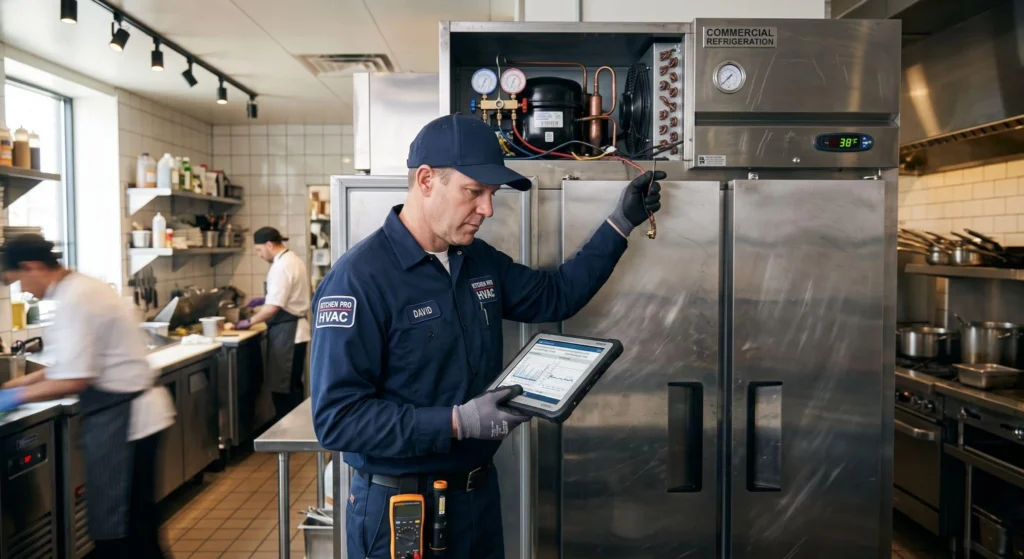
This is where commercial equipment stops resembling anything in a home kitchen. The ranges below are planning figures for equipment plus typical installation. Configuration, access, and electrical work move them around.
| Equipment | Typical replacement cost | Common repair range | Repair usually wins under |
| Single-door reach-in cooler | $1,500 to $3,000 | $150 to $800 | $900 |
| Two or three-door reach-in | $3,000 to $7,000 | $200 to $1,400 | $1,800 |
| Glass-door merchandiser | $2,000 to $6,000 | $200 to $1,100 | $1,500 |
| Small walk-in cooler, installed | $8,000 to $15,000 | $300 to $4,500 | $5,000 |
| Large or custom walk-in, installed | $15,000 to $40,000 | $500 to $6,500 | $9,000 |
Most of the variation inside those ranges comes down to two things. Self-contained units, where the refrigeration sits on the unit itself, are cheaper to service than remote systems with a condenser on the roof. And refrigerant type matters, since older R-22 equipment costs more to charge every year while newer low-GWP systems need a technician trained on them.
Two things jump out of the table. A $900 repair quote is a hard no on a small reach-in and an easy yes on a walk-in. And the diagnostic fee, typically $75 to $150 in the Midlands, is the cheapest money in this entire decision. Skipping it to guess from a symptom is how operators end up replacing a $12,000 walk-in over a $400 fan motor.
Neither column above is the whole cost, though. Three line items rarely make it onto either quote:
- Product loss. A unit that fails overnight can cost $200 to $800 in spoiled inventory before a technician arrives, and more if it happens going into a weekend.
- Lead time. A reach-in can often be replaced within days. A walk-in with custom panels can take three to six weeks, and renting refrigerated storage in the meantime is a real weekly expense.
- Install extras. New equipment pricing rarely includes delivery, haul-away, electrical work, or drain modifications. Budget several hundred dollars on a reach-in and considerably more on a walk-in.
Ice machines sit in the middle of that table. Wagner handles ice machine service alongside cooler and freezer work, and the same age-and-percentage math applies there.
When Replacement Beats Repair on Commercial Equipment
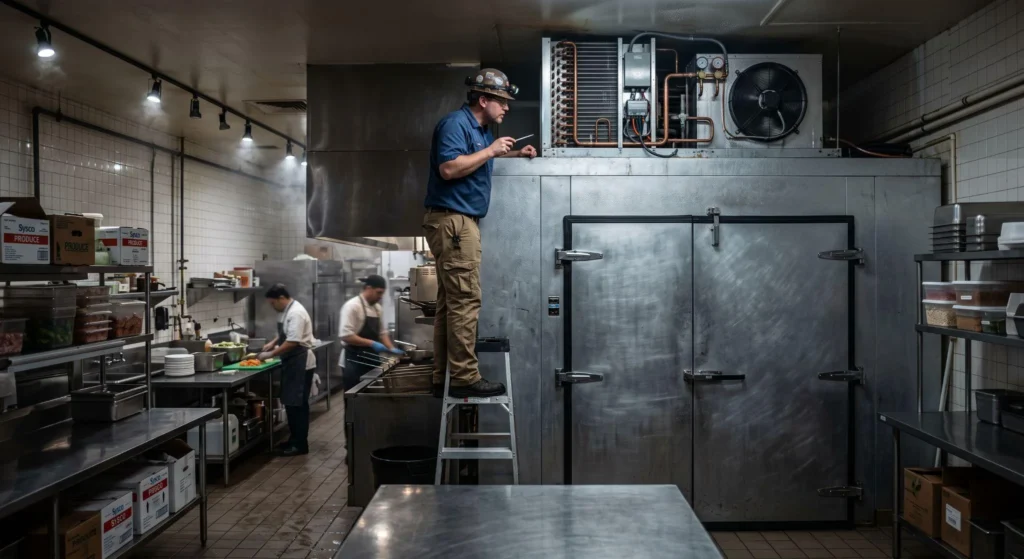
There are situations where writing the check for new equipment is the better business decision, even when a repair is technically possible.
- The unit is past 15 years and just had its first major failure
- The repair quote clears 50 to 60 percent of replacement on a self-contained unit
- Two or more systems are failing at once
- The unit still runs R-22, which gets harder and costlier to source every year
- Walk-in panels are wet, sagging, or delaminating
That last one matters more than anything else on a walk-in. Waterlogged panels mean a new refrigeration system spends its whole life fighting failing insulation, and you pay twice: once for the system now, once for the box in two years.
Press on a suspect panel. If it gives, or if condensation is tracking between the seams, the box is the problem and no compressor will fix it.
Why a Failed Compressor Changes the Math
Compressors are the single most expensive component in most self-contained units, commonly $600 to $1,500 installed. On a five-year-old reach-in, that can still clear the 50 percent test. On a 12-year-old unit, it rarely does, and a compressor failure on aging equipment usually means the rest of the sealed system has been working just as hard.
The Energy Bill That Never Shows Up on the Quote
Refrigeration is one of the largest line items on a restaurant or retail power bill, and older equipment quietly makes it worse.
ENERGY STAR’s efficiency figures for commercial refrigerators and freezers put certified units at roughly 20 percent better than standard models. A certified glass-door freezer saves about 900 kWh and more than $110 a year, which works out to around $980 over its service life.
Against pre-2010 equipment the gap is wider still. Run that across four or five units and it belongs in the replacement conversation, not as an afterthought.
Is It Worth It to Fix a Broken Fridge or Should I Just Buy a New One?
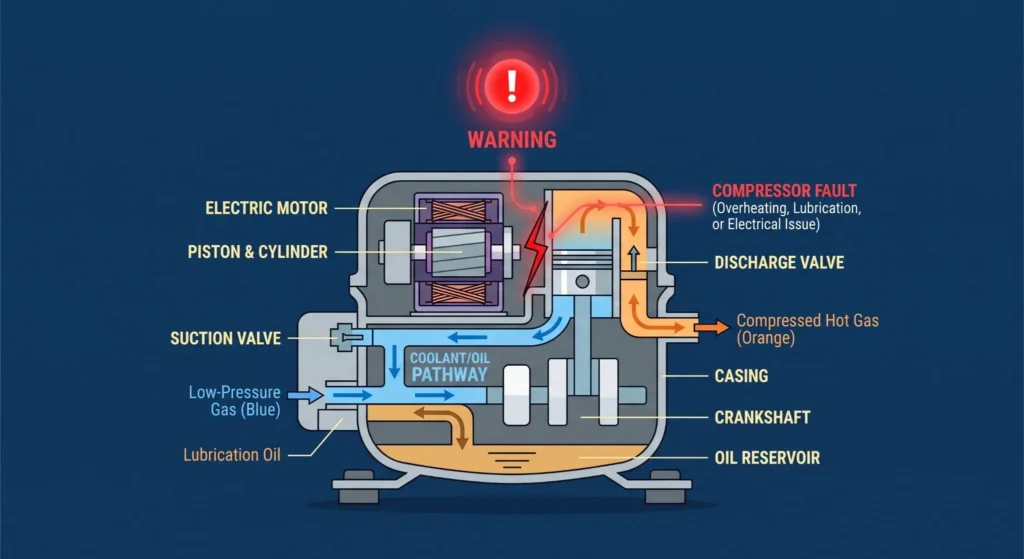
This question comes up constantly, and the honest answer is that nobody can give you a number until someone opens the unit. What is broken drives the entire decision.
It might be a $200 fan motor and 20 minutes of labor. It might be a compressor on a 14-year-old box, in which case you are better off pricing replacements. Both situations look identical from the front of the house: the unit is warm and the product is at risk.
Three checks worth doing before the phone call:
- Listen. If neither the compressor nor the fans are running, note that. It changes where a technician starts.
- Look at the condenser coils. Coils packed with grease and dust make a healthy unit act like a failing one. On rooftop-mounted or remote systems, the same principle applies to the commercial HVAC equipment sharing that space.
- Count last year’s repairs on this specific unit. One repair is a data point. Three in 18 months is a pattern.
The one thing not worth doing is deciding based on age alone. A 12-year-old walk-in with sound panels and a dead condensing unit is often the best value repair in the building. Meanwhile a six-year-old reach-in that has already needed three service calls is telling you something a spec sheet never will.
What Your Staff Can Handle and What Needs a Licensed Technician

Some of this is genuinely manageable in-house. Some of it is a federal violation if you attempt it without certification.
Safe for Your Team
- Replacing worn door gaskets
- Cleaning condenser coils on a regular schedule
- Verifying thermostat settings and clearing blocked vents
- Checking that doors close and seal fully
- Keeping the area around the condenser clear
Call a Certified Technician For
- Compressor diagnosis and replacement
- Any refrigerant work, which requires EPA Section 608 certification under federal law
- Electrical faults and control board failures
- Defrost system problems
- Anything where the cause is not obvious
Most of the in-house list is covered under a scheduled preventive maintenance plan anyway, which is the cheapest way to keep repair quotes small.
Annual preventive maintenance on commercial refrigeration typically runs $300 to $500 per unit. That is the difference between a $250 gasket job caught early and a $1,200 compressor slowly killing itself against a door that will not seal.
Know the Number Before You Approve the Repair
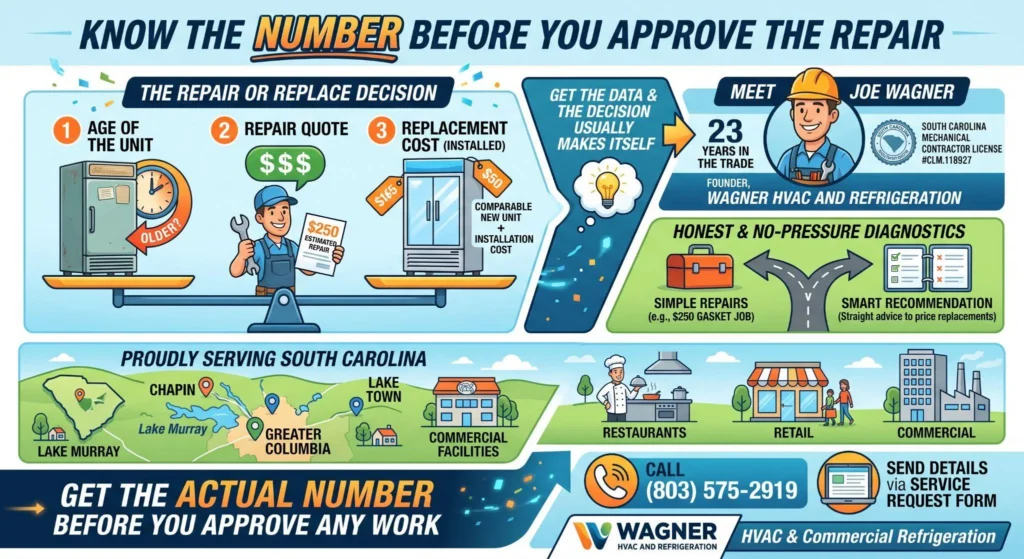
Deciding whether to repair or replace commercial refrigeration comes down to three figures: the age of the unit, the repair quote, and what a comparable replacement actually costs installed. Get all three in front of you and the decision usually makes itself.
Joe Wagner spent 23 years in the trade before founding Wagner HVAC and Refrigeration, and the company operates under South Carolina Mechanical Contractor License #CLM.118927. Diagnostics are honest and no-pressure, whether that means a $250 gasket job or a straight recommendation to price replacements.
Wagner serves restaurants, retail, and commercial facilities and has an HVAC contractor office that covers Chapin, the Lake Murray area, and the greater Columbia region. Call (803) 575-2919 or send the details through Wagner’s service request form, and you will get the actual number before anything gets approved.
FAQs About Is It Worth It to Repair a Refrigerator
How Old Is Too Old for a Commercial Cooler?
For self-contained reach-ins, 12 to 15 years is the practical ceiling, and continuous operation pushes many units toward the lower end. Walk-ins are different because the box outlives the refrigeration system by a decade or more, so age alone tells you very little. Judge the panels and the condensing unit separately.
Does a Repair Come With Any Warranty?
Parts typically carry a manufacturer warranty of 90 days to a year, and labor terms vary by contractor. Ask before the work starts, because it factors into the total cost comparison. A new unit usually arrives with a one to five year warranty on the sealed system, and that coverage is part of what you are buying.
FAQs About Wagner HVAC and Refrigeration
What Areas Does Wagner Cover?
Chapin, the Lake Murray area, Irmo, Lexington, Ballentine, and the greater Columbia region across the Midlands of South Carolina. Commercial service calls are scheduled around your operating hours where possible.
Can Wagner Help Plan a Replacement Rather Than Just Repair It?
Yes. That includes sizing the new unit to actual volume, coordinating installation, and identifying utility rebates on qualifying equipment before the purchase.