

A standard household refrigerator draws 3 to 6 amps while running on a 120-volt circuit. So how many amps does a refrigerator use the instant the compressor starts? Far more, briefly. That spike is what trips breakers, and it is the same behavior we track on any residential heating and cooling system across the Midlands. Draws vary by cabinet style:
| Refrigerator Type | Running Amps | Startup Surge |
| Mini or compact | 0.5 to 2 amps | 3 to 6 amps |
| Top-freezer | 3 to 5 amps | 9 to 15 amps |
| French door or bottom-freezer | 4 to 6 amps | 15 to 25 amps |
| Side-by-side | 6 to 8+ amps | 15 to 27 amps |
What Refrigerator Amps Actually Measure
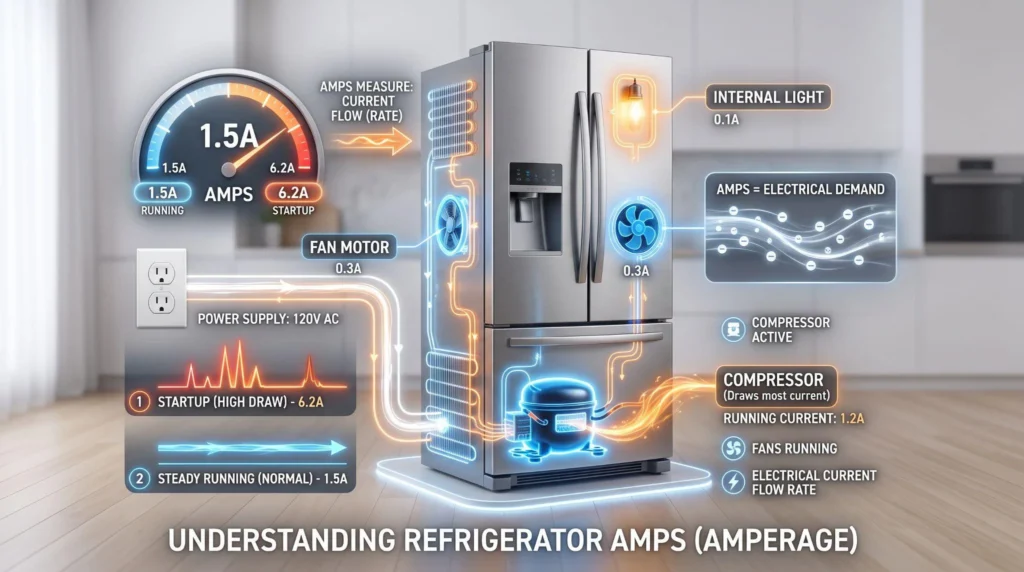
Amperage is how much current moves through a circuit at a given moment; voltage is the pressure behind it. Multiply the two and you get watts, which is what your utility bills you for. Three behaviors explain those wide ranges:
- Inrush current. When the compressor motor turns over, draw jumps into the double digits, commonly 12 to 20 amps and higher on large units, then settles within about a second.
- Circuit requirements. The NEC lets a kitchen refrigerator share a 20-amp small-appliance circuit, but also permits an individual branch circuit rated 15 amps or greater. A dedicated circuit is the standard build, and required for a garage or utility-room unit.
- Defrost cycle. Once or twice a day the defrost heater adds roughly 4 to 5 amps, about 500 to 600 watts, on top of normal operation.
Scale inrush up and you get the sizing problem behind commercial HVAC systems.
How Many Amps Does a Refrigerator Use Day to Day?
Your compressor does not run around the clock. It cycles to hold temperature, working roughly 30 to 50 percent of the time. That percentage is the duty cycle, and it turns amps into dollars:
- 5 amps × 120 volts = 600 watts while running
- 600 watts × 40 percent duty cycle = 240 watts averaged out
- 240 watts × 24 hours = 5.76 kWh per day
- 5.76 kWh × 30 days = about 173 kWh per month
Multiply that by your rate per kWh for the monthly cost. Habits move it more than people expect. Under controlled laboratory testing, a 190-liter refrigerator used about 0.70 kWh over 24 hours with the door shut, and about 1.18 kWh when opened six times a day for a minute each time. That is a 69 percent swing from behavior alone. Worn gaskets and dirty coils push it further, which is the reasoning behind a scheduled maintenance plan.
Three Ways to Measure Your Refrigerator’s Amp Draw
Published ranges only go so far. Three methods find the number for your own unit:
| Method | Cost | What It Gives You | Accuracy |
| Nameplate inside the door | Free | Rated amps or watts | Moderate |
| Yellow EnergyGuide label | Free | Estimated annual kWh | Low to moderate |
| Plug-in energy monitor | $20 to $50 | Live amps, watts, running kWh | High |
The nameplate sits inside the fresh food compartment or on the back panel; if it lists watts, divide by 120 for average amps. The EnergyGuide label gives annual kilowatt-hours, so divide by 8,760 for an hourly average. Only a meter shows what your unit actually does in your kitchen.
How Much Amperage Does a Refrigerator Draw When It’s Already Cold?

This one comes up constantly, and the intuitive answer is wrong. Two things explain why.
Why Cold Does Not Mean Low Draw
On a conventional unit the compressor is a switch, not a dial: it pulls full running amps or nothing. Reaching temperature shortens the minutes of high draw without lowering the draw itself. Between cycles you are down to fans and electronics, usually under an amp. Inverter compressors modulate speed, so they are the exception. You cannot time other appliances around it either, because the thermostat decides when the compressor starts.
What Changes in a South Carolina Summer
Ambient heat drives duty cycle, and the Midlands supplies plenty of it. In a Chapin or Irmo kitchen in July, the gap between cycles shrinks and the average climbs. Garage and porch units take the worst of it. An unconditioned Midlands garage regularly runs hotter than the ambient range most refrigerators are rated for, so the second fridge holding drinks out there often costs more than the one in your kitchen and gives out years earlier. Meter it before you blame the appliance.
Turning an Amp Reading Into a Decision

Three to six amps running, more at startup, answers the question. The number that saves you money is the one you take twice, because a draw that climbs and stays there means something changed mechanically, and catching it early is the difference between a gasket and a compressor.
Reading equipment that way is the daily work behind our commercial refrigeration service: reach-in coolers, walk-in coolers and freezers, and ice machines for restaurants and retailers. We do not service household refrigerators. For homeowners, the equipment we work on is your heating and cooling system, where the habit is identical.
One Midlands homeowner who found us through Angi described a call with the house above 90 degrees and the AC fan motor dead. Other companies had quoted a full replacement. The fault was a new thermostat wired incorrectly, and the repair cost a service call. That instinct comes from Joe Wagner’s 23 years in the trade, most of it in South Florida and the last five here in South Carolina, under SC Mechanical Contractor License #CLM.118927.
So put a meter on it, write the number down, and check again in a month. If it has moved and you want a straight answer instead of a quote for new equipment, call (803) 575-2919 or email Joe@wagnerhvacr.com. We cover Chapin, Columbia, Lexington, Irmo, and the surrounding Midlands service area.
FAQs About “How Many Amps Does a Refrigerator Use?”
Can a refrigerator share a 15-amp circuit?
Code allows it in a kitchen, but the startup surge makes it risky beside another motor or heating load.
Why is my measured draw below the nameplate?
The nameplate lists a worst case. Your meter reads real operation, which is lower most of the time.
FAQs About Wagner HVAC and Refrigeration
Do you repair household refrigerators?
No. Refrigeration work is commercial only. Homeowners we serve for heating and cooling.